Introduction
Nails are one of those small details that quietly shape how put-together we feel. Nobody photographs their feet for a profile picture, yet the moment sandal season arrives, a pool invitation lands, or a yoga class asks for bare feet, nail appearance suddenly matters a great deal. The same is true at work: a handshake, a keyboard, a presentation — fingernails are on display far more often than we notice.
The concerns people raise are remarkably consistent. Nails that have turned dull or uneven in colour. Surfaces that feel rough or ridged rather than smooth. Edges that chip, split, or thicken with age. Toenails that look tired after months inside trainers, work boots, or ski socks. None of these are unusual, and none of them mean something is wrong with you — they are the ordinary result of daily life, footwear, moisture, and time.
What frustrates most people is not the concern itself but the effort involved in doing anything about it. Traditional nail care often means a bottle with a shared brush, a basin of warm water, cotton pads, a towel you do not mind ruining, and fifteen minutes you do not really have. Routines like that survive about a week. Then the bottle moves to the back of a cupboard and nothing changes.
This is the gap the Orivelle Fungus Pen aims to close. It is a compact, pen-style nail care product built around a single principle: if a routine is genuinely quick, tidy, and portable, people will actually stick with it. In this Orivelle Fungus Pen review we look at what the product is, how it is used, who it suits, how it compares to conventional approaches, and what real customers say after weeks of use.
What Is Orivelle Fungus Pen?
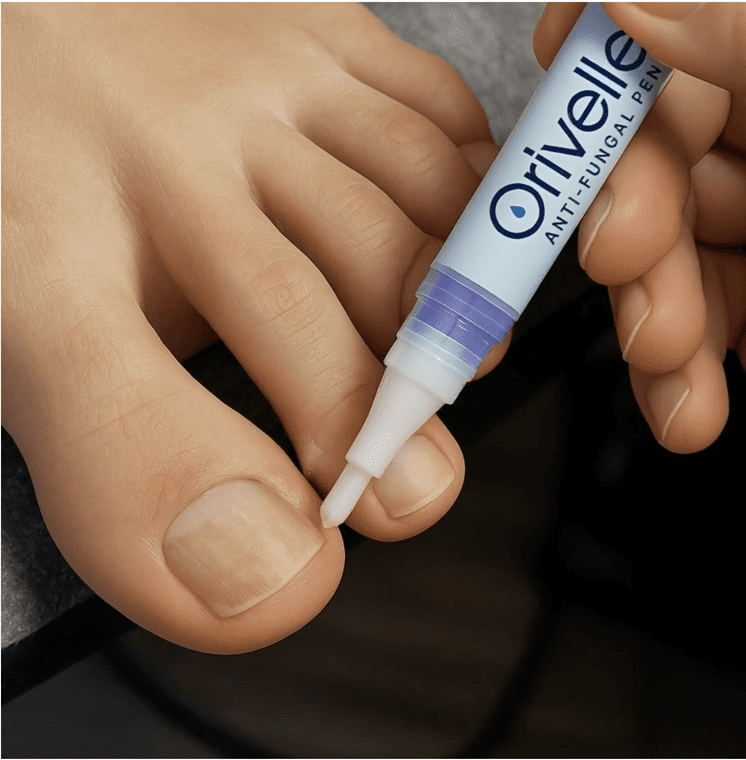
Orivelle Fungus Pen is a nail care pen: a slim barrel, roughly the size of a highlighter, containing a topical nail care formula that is dispensed through a fine applicator tip at one end. You twist the base a few clicks, the tip becomes lightly saturated, and you trace it across the nail. That is the entire mechanism — no droppers to squeeze, no brush to dip, no lid to balance on the edge of a sink.
The design decisions are all in service of everyday practicality. The barrel is thick enough to grip comfortably, which matters more than it sounds if you have larger hands, reduced dexterity, or are bending awkwardly to reach a toenail. The cap seals firmly, so the pen can sit in a handbag, gym bag, or suitcase without any risk of leaking over the contents. The tip is narrow enough to follow the curve of a nail and run along the cuticle line and side walls, where a wide brush would simply flood the surrounding skin.
Its intended use is straightforward: a supportive step in a regular nail care routine for fingernails and toenails, applied to clean, dry nails once or twice a day. It is not a device, it requires no charging or accessories, and it is designed entirely for home use. In practice, most people keep one in the bathroom and a second in a bag or desk drawer so the routine survives travel and long working days.
Where it fits into a daily nail care routine is at the end. Trim nails straight across, file down anything rough or catching, wash and dry thoroughly — particularly between the toes — then finish with a pass of the pen. The whole sequence adds well under two minutes to a morning or evening, which is precisely why people manage to keep it going.
Why Are Nail Care Problems So Common?
Environmental exposure. Nails spend their lives in contact with the world. Communal showers, gym changing rooms, pool decks, hotel carpets, and shared bathmats all place feet on surfaces that stay warm and damp. Add gardening, cleaning products, dishwater, and frequent hand sanitiser and it is easy to see why nail surfaces gradually lose their smooth, even look.
Moisture buildup. Nails and the skin around them respond poorly to prolonged dampness. Sweat trapped inside a shoe for a nine-hour day, socks that were not quite dry, or feet towelled off in a hurry after a shower all leave moisture sitting exactly where you least want it. The classic oversight is skipping the gaps between the toes, which stay wet long after the rest of the foot has dried.
Tight footwear. Narrow toe boxes, stiff work boots, running shoes half a size too small, and formal shoes worn all day press on the nail plate. Repeated pressure and rubbing can leave nails thickened, ridged, or discoloured at the tip. Runners, hikers, footballers, and anyone on their feet in safety boots know this pattern well.
Poor nail maintenance. Habits matter more than products. Cutting nails too short or curving the corners, tearing rather than trimming, reusing clippers without cleaning them, and leaving nail polish on for weeks at a time all contribute. So does the simple absence of a routine — most people only think about their toenails when something already looks off.
Aging-related nail changes. Nails change naturally over the decades. Growth slows, the plate thickens, longitudinal ridges become more visible, and colour shifts towards a duller, more yellowish tone. This is normal biology, not neglect, but it does mean older adults often want a maintenance routine that is easy on the hands and quick to perform.
Lifestyle factors. Long commutes in closed shoes, frequent flying, back-to-back gym sessions, shift work, and stressful periods where self-care slips down the list all play a role. Nutrition, hydration, and smoking influence nail quality too. None of these are dramatic on their own, but they accumulate — which is why a small, sustainable daily step tends to outperform an ambitious routine you abandon in a fortnight.